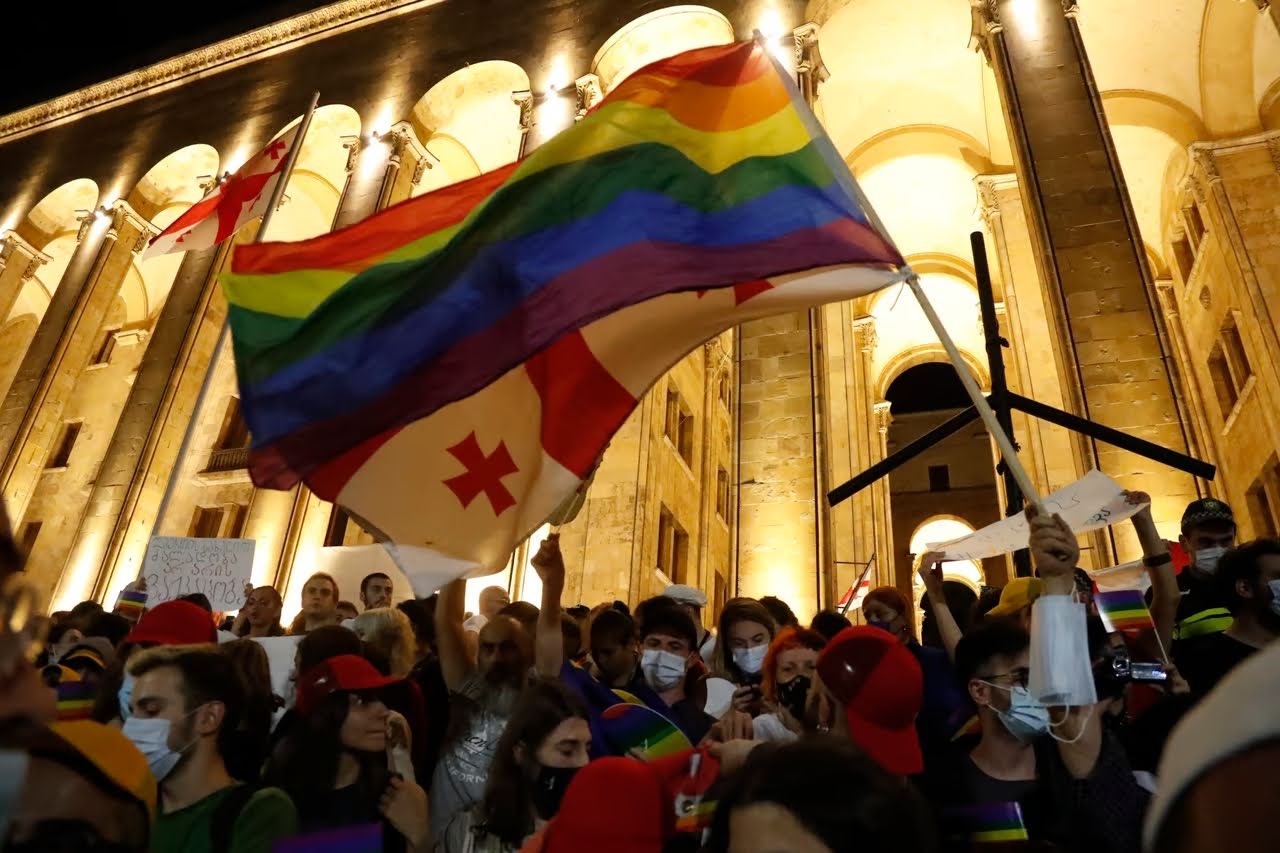
OSCE/ODIHR has published its annual Hate Crime Report, including over 80 cases documented by the Eastern European Coalition for LGBT+ Equality and its members.
Across Eastern Europe, anti-LGBT+ hate crime remains a daily reality, and most of it never reaches official statistics.
In 2024, reports from Armenia, Georgia, Ukraine and Moldova show the same patterns:
- The state looks away. Police often fail to record bias motivation, misclassify incidents, or do not publish data at all.
- Home is not always safe. Family members and neighbours are frequent perpetrators, turning the private sphere into a site of chronic violence, blackmail and confinement.
- Violence is intersectional. Trans and non-binary people, refugees, and ethnic minorities face layered attacks where anti-LGBT+ bias overlaps with sexism, racism, xenophobia or anti-migrant hate.
- Trans people and gay men are at highest risk. They are disproportionately targeted with severe physical violence, economic exploitation and public humiliation.
- Civil society does the state’s job. Community organisations are the main source of reliable data, support survivors and push authorities to act, often with very limited resources.
Armenia
Violence often starts at home: many of the 49 incidents documented by civil society involve physical assaults by family members and domestic confinement. Police routinely treat these as “ordinary” family disputes, ignoring bias motivation. Gay men are also targeted for blackmail and violent robbery, showing how homophobia is used for economic exploitation.
Georgia
Georgia has stronger laws and one landmark case in 2024, when the murder of a trans woman was recognised and sentenced as a bias-motivated crime. Yet trans women still face extreme violence, and LGBTI+ people continue to experience coercion and confinement by relatives after coming out. Legal frameworks exist, but protection on the ground is far from guaranteed.
Ukraine
With no official data, we rely entirely on 97 incidents reported by civil society. Many attacks are carried out by organised extremist groups targeting gay men and trans people, operating with near total impunity. Neighbours are also among perpetrators, revealing deep community-level hostility that cannot be solved by legal reforms alone, but requires broader social change.
Moldova
The gap between state and reality is stark. Police recorded only one anti-LGBT+ case, while civil society documented 14 incidents, many involving physical assaults during Pride and in public spaces or on public transport. Authorities frequently misclassify these attacks as “simple disturbances”, erasing the hate motive. Refugees and ethnic minorities, such as Ukrainian and Roma, face intersecting forms of violence.